
Use It as Your Second Brain
An evening exploring how AI is changing the way we learn, think, and make sense of the world.
At our latest AI Portland panel, we explored what that means for students, educators, parents, and the rest of us.
Listen to the Episode
A companion podcast episode related to this story.
Last Thursday, November 12, AI Portland brought together educators, researchers, parents, and curious minds for our second conversation about AI and education. Our first event focused on what was happening in schools as AI entered classrooms. This time, we went a little deeper, exploring how these tools are changing the way we think, learn, and relate to the world around us.
The conversation covered everything from cognitive offloading and childhood development to the difference between intelligence and insight. We talked about the responsibilities of educators, the anxieties of parents, and what happens when a technology starts to feel less like a tool and more like something we have a relationship with.
Our panel brought together three perspectives: Mohan Nair, author of Unreachable: How Not to Lose Your Mind in an AI-Obsessed Era; Seth Fleischauer, Founder and President of Banyan Global Learning and host of Make It Mindful podcast; and Dr. Rachel Brown, Assistant Professor of Computer Science at Willamette University and former NVIDIA engineer. AI Portland co-founder Megan Notarte moderated, bringing her own perspective as a current student into the conversation.
It's not a calculator
One of the first questions we explored was what makes AI fundamentally different from the technologies that came before it.
Seth offered an interesting distinction: AI is relational. Nobody has a relationship with their calculator, but conversational AI mimics human interaction in ways that previous tools haven't. We ask it questions, share our frustrations, seek advice, and sometimes turn to it for reassurance. It can offer opinions, suggest ways of thinking about a problem, and respond in ways that feel remarkably personal.
That distinction becomes especially important when we think about young people, who are still developing their understanding of relationships, authority, and trust. When a chatbot becomes the first place a student turns for help, there's more happening than simply finding an answer.
Your second brain
One of the most interesting threads of the evening was cognitive offloading, the practice of using tools to take over some of our mental work.
The panel discussed two different kinds. The first is offloading something you've already learned to do. Think about using a calculator after you've learned arithmetic or asking AI to summarize material you already understand. You've built the foundation, and the tool frees up mental energy for something else.
The second is offloading something before you've ever learned how to do it yourself. That's where things get complicated, particularly for children who are still developing foundational skills.
For adults who grew up learning without AI, we have years of experience to draw from when evaluating what these systems produce. Kids are building that experience right now, often with AI readily available to do the work for them.
Mohan offered a framing that stayed with us: Use AI as your second brain.
It's a useful way to think about the role we want these tools to play in learning. They can help us explore ideas, work through problems, and extend our capabilities, while leaving room for the struggle, repetition, and discovery that help us develop understanding in the first place.
Intelligence, insight, and the art of figuring things out
Another fascinating part of the conversation centered on the distinction between intelligence and insight.
AI gives us access to an extraordinary amount of information and can help us reason through complex problems. But insight is a different experience. It's that unexpected realization that arrives in the shower, on a walk, or after you've spent days wrestling with something. It often comes from connecting ideas through your own experiences and understanding.
The word orthogonal came up several times during this part of the conversation. I'll admit, I nodded along each time without being entirely sure what it meant. Naturally, I looked it up afterward.
In geometry, orthogonal means at right angles. In the context of our discussion, it described the way insight can arrive from an unexpected direction, opening up a possibility you hadn't previously considered.
It reminded Megan and me of something we heard a few weeks earlier at the Artificiality Summit in Bend. Researcher Adam Mastroianni talked about the importance of recognizing when we don't actually understand something we thought we did. That moment of uncertainty can be the beginning of real discovery.
There's something interesting about how easily AI can give us the feeling of understanding. We get a clear explanation, it makes sense, and we move on. But sometimes the most valuable part of learning happens when we sit with the confusion a little longer.
So, what about the kids?
Naturally, much of the conversation came back to children and education. Parents and educators are trying to make decisions about technologies that are evolving faster than the research and policies surrounding them.
The panel generally favored a developmental approach to introducing AI, with greater caution around open-ended AI tools for children younger than middle school. As students develop foundational skills and judgment, they can gradually take on more independence with these technologies, much like moving from a learner's permit to a driver's license.
There were important nuances to that conversation, particularly around tools designed for specific learning needs. Accessibility supports such as text-to-speech, translation, and dyslexia aids can provide tremendous value, and those benefits deserve consideration when schools establish AI policies.
One of my favorite moments came when a parent in the audience asked how we should be handling all of this at home.
Mohan's advice was refreshingly simple: relax.
Kids pick up on our anxiety, and our own relationship with technology shapes theirs. Being present, staying curious, and modeling thoughtful behavior can go a long way. Seth added that we should also pay attention to the media environments children are growing up in.
There aren't easy answers here, but the discussion offered a useful reminder that parents and educators have an important role in helping kids develop the judgment they'll need to navigate these tools.
Reasons to be optimistic
For all the concerns raised during the evening, there were also reasons to feel hopeful.
Rachel shared how AI is prompting her to reconsider what she actually wants students to learn. If AI can write code, for example, what is the deeper purpose of teaching programming? Is it the syntax itself, or the problem-solving, logic, and ways of thinking students develop along the way?
Those are valuable questions for education, regardless of where AI goes next.
Seth also raised one of the more concerning possibilities: that conversational AI could interfere with how young children develop relationships with other people. Given how convincingly these systems can simulate human interaction, it's a question worth taking seriously.
And yet, looking around the room that evening, I found plenty of reasons for optimism. People had come together after work to listen, ask thoughtful questions, challenge ideas, and learn from one another. The conversations continued well after the panel ended.
We're curious, social creatures. We learn from our own experiences, but we also learn through conversations, relationships, and the perspectives of people whose lives look different from ours.
That's a big part of why we keep bringing people together at AI Portland. As these technologies become more embedded in our lives, having places where we can explore their implications together feels increasingly valuable.
Thank you
A huge thank you to Mohan Nair, Seth Fleischauer, and Dr. Rachel Brown for sharing their perspectives, and to Megan Notarte for guiding such a thoughtful conversation. We're also grateful to Kiln for helping make the evening possible, and to everyone who joined us and contributed to the discussion.
Special thanks to Roberto Santiago for joining us in the audience.
Keep the conversation going
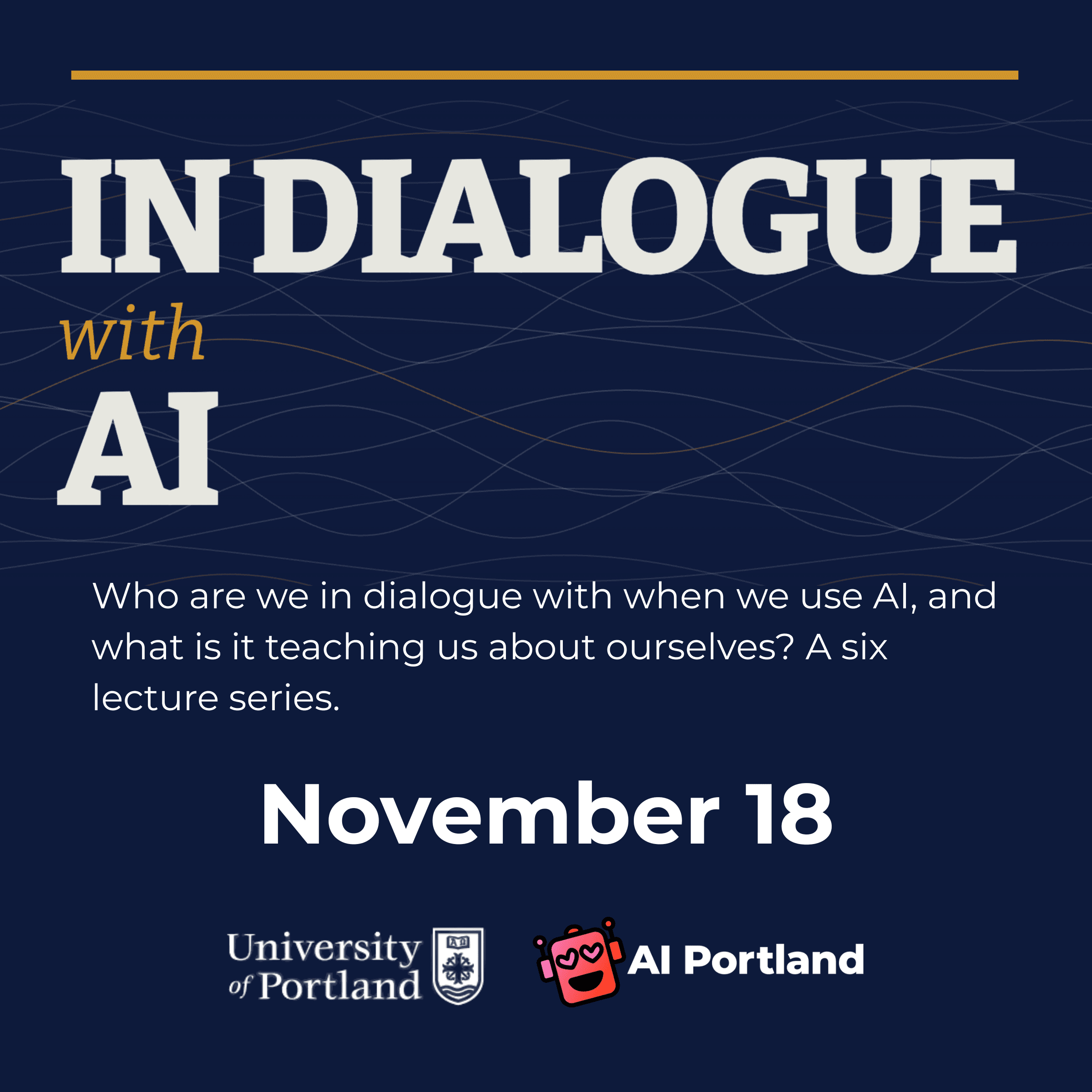
If this conversation sparked your curiosity, Roberto Santiago is continuing his In Dialogue with AI lecture series with the University of Portland.
Wednesday, November 18
We hope to see you there.
Come Hang Out With Us
WED, NOVEMBER 18
In Dialogue with AI: The Promise (Night 3)
University of Portland
RSVP for Event
TUE, DECEMBER 1
Wikipedia at 25: A Fireside Chat with Selena Deckelmann CPO/CTO Wikimedia Foundation
Upstart Collective
RSVP for Event